The chunk makes by_male first, so the sentence can use it.
Bug 3: what each order renders
✗ Out-of-order render: it fails
In the Background Jobs tab:
Error in eval(parse_only(code), envir = envir) :
  object 'by_male' not found
Quitting from team3-notebook.qmd:45-45
No new HTML. The render stops at line 45
Any HTML you already had is the old one. Check its time stamp before you trust it
✓ Correct-order render: it works
In the rendered HTML:
Step 5. Summaries
We measured 7 males.
The number is computed, not typed: add a male and re-render, and it changes to 8
45-45 is one line: your sentence, not a chunk. A one-line range in the error means inline code. Move the sentence below the chunk that makes the object.
In your team notebook
by_male and by_species are made in Step 5. Every sentence with a number from them goes after the Step 5 chunk:
We measured `r sum(by_species$n_calls)` calls from`r sum(by_species$n_males)` males of `r nrow(by_species)` species.
Two more things that look like a bug but aren’t:
The sentence only updates when you click Render. Running chunks or Run All doesn’t change it, in the editor or in the last HTML
Render starts a fresh R session. A value you changed in the Console doesn’t count. Change it in the notebook
Four observers, one dataset
You split the recordings and pool the numbers. That only works if every observer would have put the boundaries in the same places. Two rules, written in your notebook before anyone measures:
1. Which calls count (the window rule)
The first ten consecutive calls with no handling noise and no overlapping frogs. The first clean run, not the best-looking calls, so two observers land on the same calls
Don’t skip a call inside the run. Intervals come from consecutive starts (lead(start_abs) - start_abs). A skipped call doubles one interval, and nothing flags it. If a call can’t be measured, end the run there
2. Where a call starts and ends (the boundary rule)
One sentence that names the panel, the threshold, and the tail: “start = first pulse at least twice the background in the oscillogram; end = end of the last pulse; echo tail excluded”
Read times from the waveform
{width=85% fig-alt=“The same marnockii call as two spectrograms. Left, a short window of 64 samples: each pulse is a sharp vertical bar, but its energy smears from 0 to 4 kHz. Right, a long window of 1024 samples: the energy is a tight band at 2.1 kHz, but the pulses blur together into a nearly continuous line.”}
At wl = 512 and 44.1 kHz each spectrogram column spans 12 ms. The spectrogram smears every edge sideways; the oscillogram doesn’t
Use the spectrogram to confirm that a blip is the frog, then read the time off the waveform
Same display for everyone:wl = 512, ovlp = 50, same flim, same zoom width. Zoom with tlim =, so the axis stays in window time and there are no offsets to add
Calibrate before you split
New: 10-observer-calibration.qmd on the share.
Today, as a team (15 min): pick one recording, write both rules
Each of you, alone: measure the same ten calls into calibration/selections_<initials>.csv. No comparing first
Steward: render. You get each observer’s habits (early starts, long ends), plus repeatability: the share of the variation that is the frog and not the observer
Together: look at the worst calls, fix the rules, re-measure if needed
Then split by male, not by file, spread each species’ males across observers, and never let two people measure the same file in the team folder. The updated template’s Step 3 stops if they do.
First 15 minutes: stand-ups, team by team. Errors you couldn’t fix go first
Next 15: calibration setup. Choose the recording, write both rules
The rest: work. Calibration selections first, then your own recordings into selections_*.csv
I’ll circulate. Bring me the exact error message, not a description of it
Stand-up: three things, two minutes
One person per team:
Does it render from scratch? Delete outputs, Restart R, Render: yes / no
The error you couldn’t fix, if there is one
What’s still done by hand
Before Monday
Steward
Everyone
Coming up
Due Sun Oct 11, 11:59 PM: the calibration notebook, rendered (steward submits on Canvas for the team).
Monday Oct 12: summary statistics and uncertainty, led by the peer mentors (I’m away). Slides are posted in advance. Bring your by_male and by_species tables and your calibration numbers.
Credits
Prepared with Claude Code (Claude Opus 5.5, Anthropic): deck drafting, including the observer-consistency slides. Alt text added Nov 3 with Claude Code (Claude Opus 5.5).
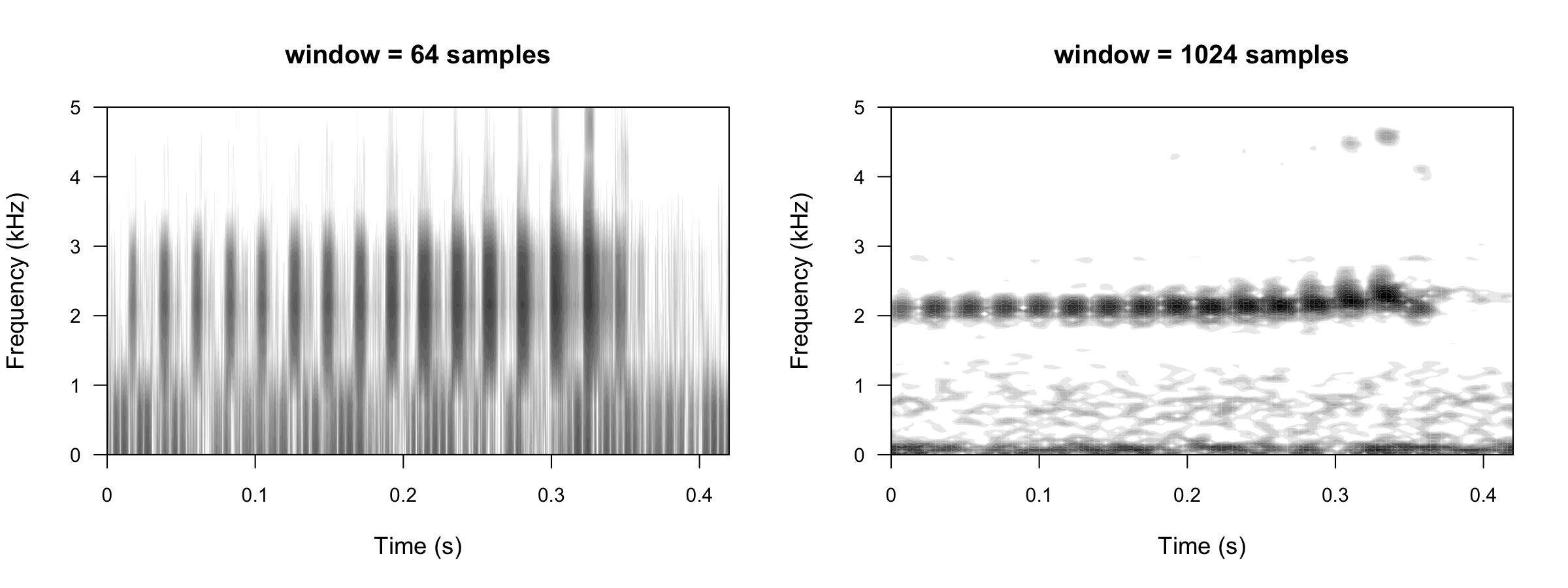 {width=85% fig-alt=“The same marnockii call as two spectrograms. Left, a short window of 64 samples: each pulse is a sharp vertical bar, but its energy smears from 0 to 4 kHz. Right, a long window of 1024 samples: the energy is a tight band at 2.1 kHz, but the pulses blur together into a nearly continuous line.”}